How this feature connects to others
Feature overview
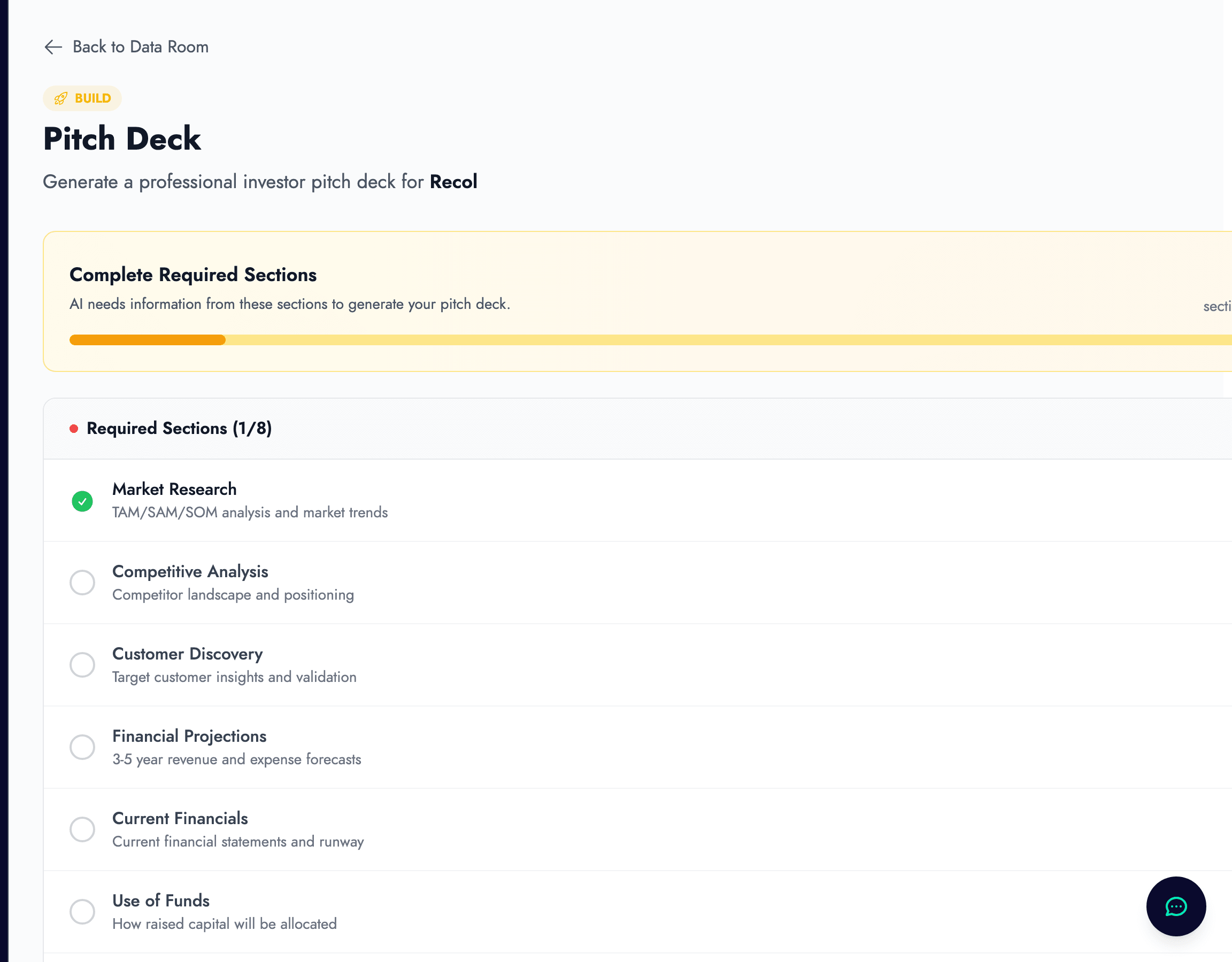
What a pitch deck is
A pitch deck is a presentation — typically ten to fifteen slides — that tells the story of your startup to investors. It covers the problem you are solving, your solution, the market opportunity, your business model, your traction to date, your team, and how much you are raising and what you will do with the capital.
Most pitch decks are created in Google Slides, PowerPoint, or Keynote. Zigzag generates pitch decks directly in Google Slides, which makes them easy to share via link, simple to edit collaboratively, and straightforward to update as your story evolves.
When to create your pitch deck
Your pitch deck should come after you have completed the foundational work: your Lean Canvas, your market research, your competitive analysis, your customer discovery, your financial projections, and your brand identity. All of these feed directly into the deck.
Creating a pitch deck before this foundation is in place tends to produce a generic, thin presentation that experienced investors see through quickly. Investors notice immediately when market research is superficial, financial projections have no supporting logic, or a competitive analysis is just a 2x2 matrix with four empty quadrants.
The structure of a strong pitch deck
Most effective decks follow a similar arc. Start by establishing the problem — not just what it is, but who has it and why it matters enough to solve. Then introduce your solution and explain why it works where existing approaches fall short.
The market section answers one question: how large is the opportunity? Investors want a realistic breakdown of your total addressable market, the specific segment you are going after first, and how you arrived at those numbers. The business model slide explains how you make money.
Your traction slide shows what you have already accomplished: users, revenue, growth rate, key partnerships, or significant milestones. Your team slide explains why this specific group of people is well positioned to solve this problem. The final slides cover your ask: how much you are raising, what you will do with it, and what milestone that capital will help you reach.
How zigzag generates your pitch deck
Zigzag generates a Google Slides deck based on all of the work you have done in the platform. Your Lean Canvas provides the problem and solution narrative. Your market research contributes the market size data. Your customer discovery findings supply the evidence of demand. Your use of funds document informs the ask slide.
The generated deck includes your logo and brand colors throughout. You will need to review and edit it carefully — every pitch deck benefits from the founder's own voice and the specific details that only you know about your business. The AI handles the structure; you provide the substance.
What investors actually look for
Experienced investors read a very large number of pitch decks. Most are declined quickly. What makes a deck worth a follow-up meeting is usually a combination of: a clear problem that seems genuinely worth solving, a team that appears credible and capable, and a market large enough to justify venture-scale investment.
Slides that are dense with text are rarely read carefully. Slides with one clear point, supported by a specific number or piece of evidence, are far more effective. The goal of each slide is to answer one question well, not to include every relevant detail.
The deck is a starting point for a conversation
A pitch deck is not a document that makes funding decisions on its own. It is a conversation starter. The goal of the deck is to make the investor curious enough to take a meeting. The goal of the meeting is to build enough trust and shared understanding to move to the next stage.
This means your pitch deck does not need to answer every possible question. It needs to answer the most important questions convincingly, and leave the rest for a face-to-face conversation where you can respond to what the investor actually wants to know.