How this feature connects to others
Feature overview
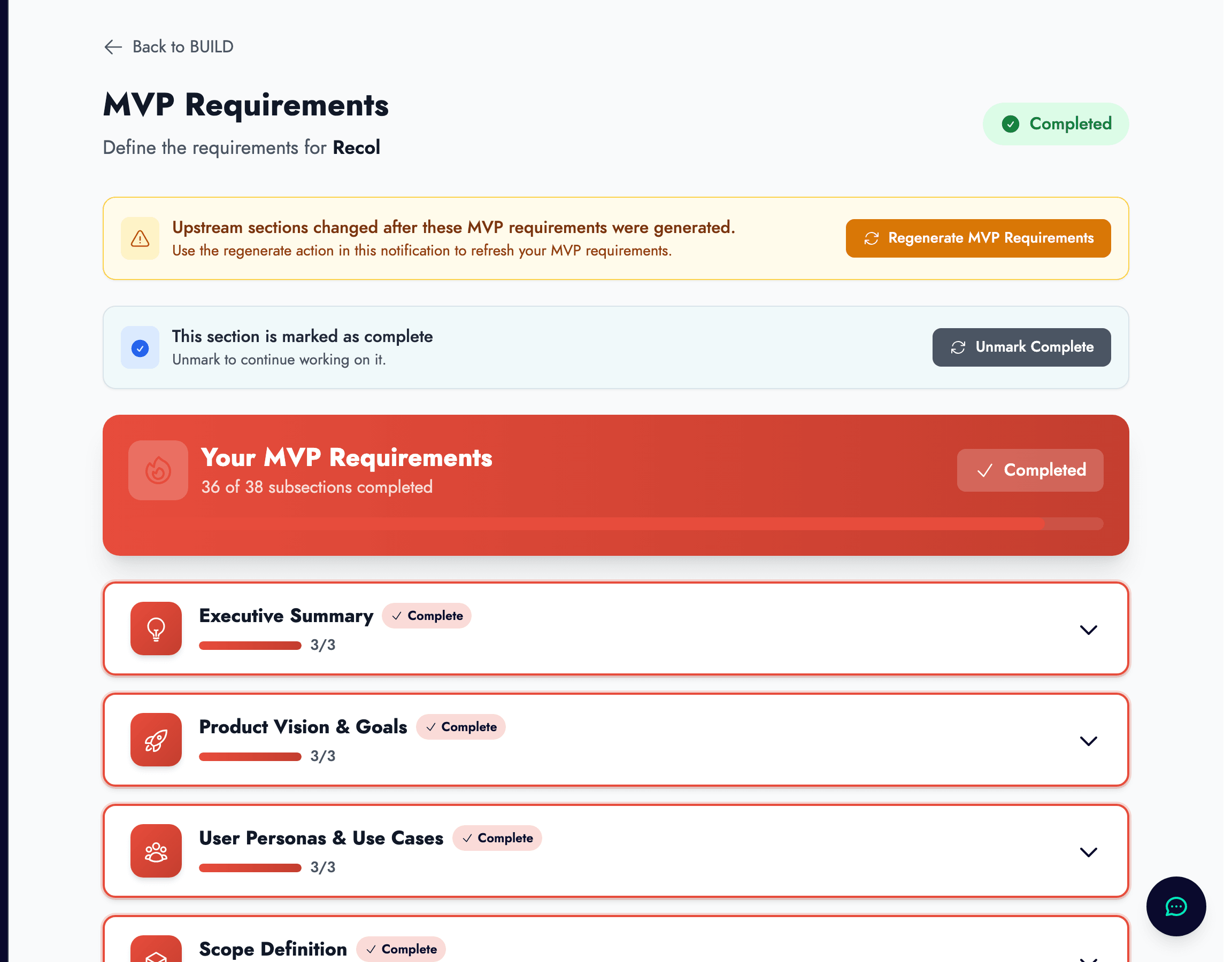
What MVP requirements are
An MVP requirements document — sometimes called a Product Requirements Document or PRD — is a written description of the product you intend to build. It covers what the product does, who it is designed for, which features are in scope and which are explicitly not, what the technical architecture should look like, and how you will measure whether the product is working.
MVP stands for Minimum Viable Product: the smallest version of your product that is useful enough for real customers to try and give you meaningful feedback. The requirements document defines what "minimum" means in your specific context.
Why writing requirements down matters
Many first-time founders start building immediately after forming an idea, without writing anything down. The result is a product shaped by whatever feels important in the moment rather than what the target customer actually needs.
Writing requirements forces you to make trade-offs explicit before you code them in. Which features are truly necessary for launch? Which can wait for version two? What should the product absolutely not do? These decisions are far easier and cheaper to revisit on paper than after they have been built.
Requirements also make it possible to get useful input from others — co-founders, advisors, or early investors — before committing to an approach. A clearly written requirements document invites meaningful feedback at the cheapest possible moment in the product lifecycle.
How zigzag generates your requirements document
Zigzag generates a twelve-section PRD based on your Lean Canvas, brand elements, and any competitive and customer discovery work you have completed. The sections are: executive summary, product vision, user personas, scope definition (what is in and out of the MVP), functional requirements, non-functional requirements, technical architecture, design and user experience principles, success metrics, launch criteria, risks and dependencies, and open questions.
The generated document is a starting point. You should expect to edit it substantially — adding specifics about your technology preferences, removing features that are not yet realistic, and updating the success metrics to reflect your actual situation. The AI generates the structure; you fill in the depth.
What makes a good MVP
A good MVP is not simply a minimal version of your product. It is the smallest version that allows you to test your most important hypothesis about whether customers will use and value your product. The features you choose for the MVP should be exactly those needed to test your riskiest assumptions.
This means the MVP should be complete enough to be genuinely usable, but not so polished that you spent months on it before learning whether the core concept works. "Will someone use this regularly enough to tell five friends about it?" is often a more useful question than "does every edge case work correctly?"
How requirements connect to MVP building
Once your requirements document is complete, it becomes the primary input for the MVP Building feature in zigzag. The code templates and scaffolding generated by the platform draw on your requirements to produce a starting codebase that matches your described architecture and feature set.
If you are working with external developers or an agency rather than building yourself, a clear, detailed requirements document is the best briefing you can provide. It minimizes misunderstandings, reduces back-and-forth, and gives developers a shared reference point throughout the engagement.
Keeping requirements up to date
Requirements documents are not permanent. As you learn from early users, you will discover that some things you specified are not what customers need, and some things you did not specify turn out to be critical. Update your requirements document as you learn. Over time, it becomes a useful record of how your thinking about the product evolved.