How this feature connects to others
Feature overview
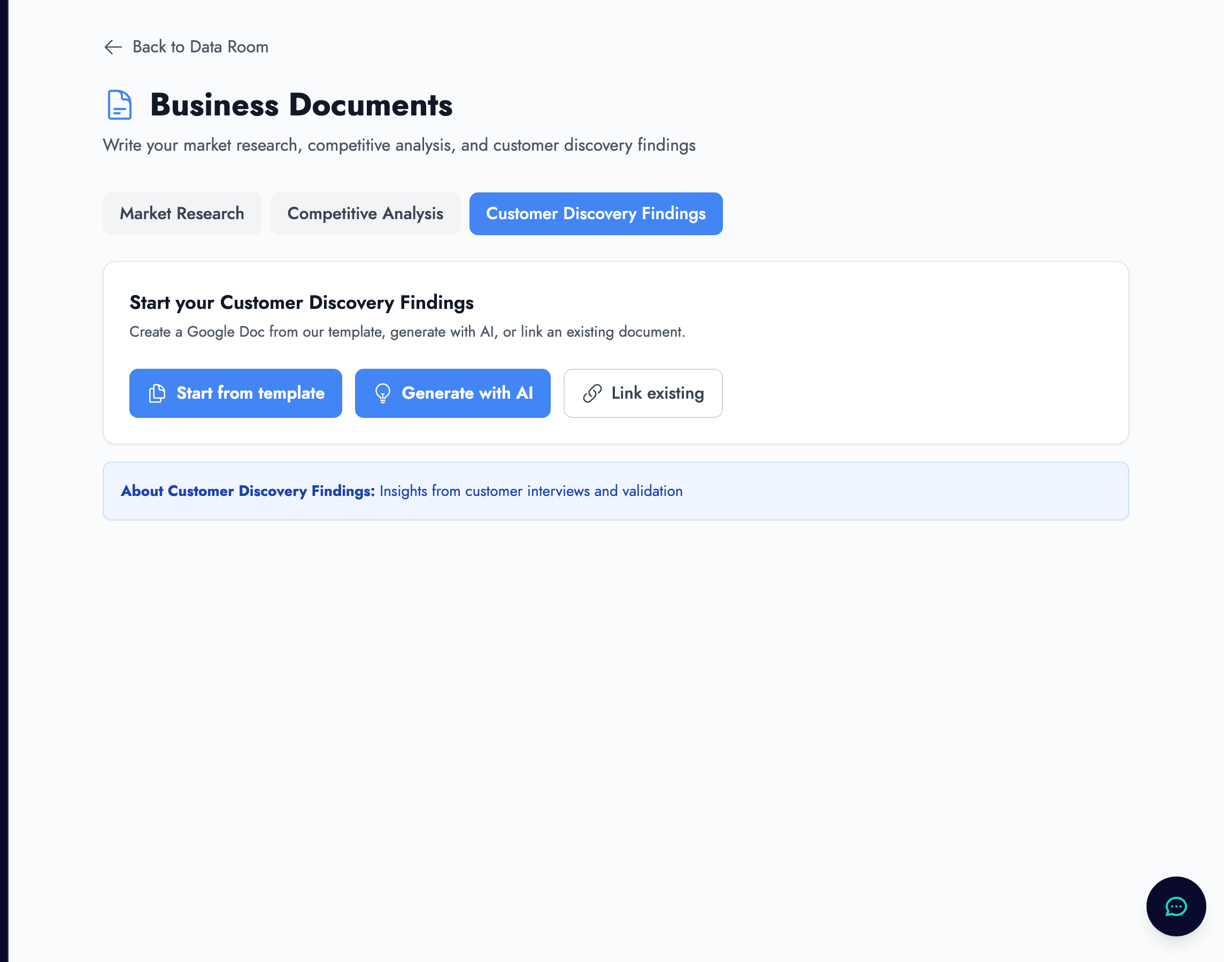
What customer discovery findings are
Customer discovery findings is a document that summarizes what you learned from your direct interactions with potential customers — your surveys, structured interviews, or any other conversations that gave you insight into their problems, behaviors, and needs.
This document transforms the raw data from your validation activities into a structured, readable report that you can share with investors, advisors, and potential team members. It captures the evidence that the problem you identified is real, painful, and experienced by enough people to build a business around.
Why this document exists separately from your survey data
Your survey analytics dashboard shows the raw response data. The customer discovery findings document tells the story of what that data means. It synthesizes patterns, highlights the most compelling direct quotes from respondents, and draws explicit connections between what you heard and what you are now building.
Investors rarely examine raw survey data directly. They want a human interpretation: what did you find, what did it teach you, and how did it change your thinking? The customer discovery document is the place to answer those questions in a way that is both honest and compelling.
What strong customer discovery looks like to investors
Investors distinguish clearly between founders who have spoken to real customers and founders who have not. The difference is usually apparent in the specificity of answers.
A founder who has done genuine discovery will say things like: "We interviewed twenty-three freelance designers across five countries. Eighteen of them mentioned the same friction unprompted: they lose two to three hours a week resolving payment disputes with clients. The painful part is not the delayed money — it is the relationship damage from the back-and-forth." That level of specificity signals real conversations. It is far more persuasive than claiming there is a large market need.
How zigzag generates the document
Zigzag generates your customer discovery document based on the survey responses collected in the platform, cross-referenced with your Lean Canvas and critical hypotheses. It produces a Google Doc that organizes the findings into key themes, notable direct quotes, and explicit connections to the hypotheses you set out to test.
Plan to edit the generated document carefully. The most compelling parts will often be specific stories or quotes from your interviews that only you have access to — not just the statistical patterns. Those details are what transform a data summary into a piece of genuine evidence.
How this connects to your product and pitch
Your customer discovery findings feed directly into two important downstream documents. First, your MVP requirements: the problems that appeared most frequently and most urgently in your discovery work should be the ones your MVP addresses most directly. This creates a direct, traceable line from customer evidence to product decisions.
Second, your pitch deck: slides that draw on specific customer discovery evidence are among the most persuasive in a well-prepared deck. They demonstrate that you validated demand before building. Many experienced investors consider strong, specific customer discovery to be the single strongest indicator of a well-prepared early-stage team.