How this feature connects to others
Feature overview
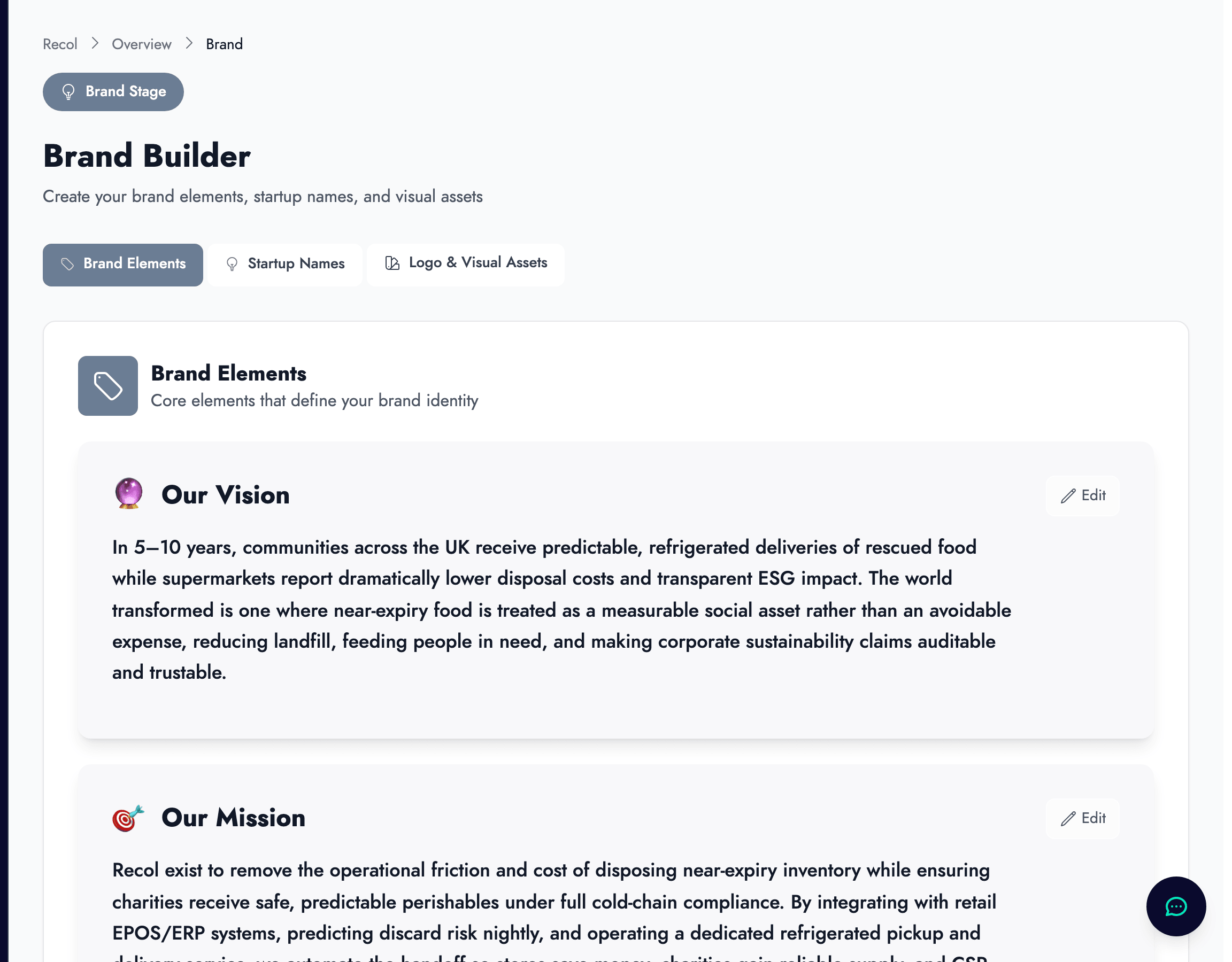
What brand elements are
Brand elements are the building blocks of your company's identity. They include your mission (why your company exists), your vision (what the world looks like when you succeed), your values (the principles that guide your decisions), your brand personality (the human traits that describe how your company behaves), and your voice and tone (how your company communicates in writing and speech).
These are not marketing slogans. They are internal reference points. They help you and your team make consistent decisions about what to build, who to hire, what to say to customers, and how to present your company to the world. A well-defined brand makes every subsequent decision slightly easier.
Why this comes after customer validation
It might seem logical to define your brand before you start talking to customers. Many founders do exactly this — they pick a name, design a logo, and write a mission statement before they have spoken to a single potential user.
The problem with that order is that your brand should reflect the reality of your customers, not just the ambitions in your head. Who you are as a company depends on who you serve and what they actually need from you.
If your validation work reveals that your customers are pragmatic, time-pressed professionals who distrust jargon, your brand voice should reflect that. If your customers are aspirational and community-oriented, your brand should be warmer and more collaborative in tone. Doing this work after your first round of customer research means your brand is grounded in real insight rather than guesswork.
Mission, vision, and values
Your mission statement describes why your company exists. It should be specific enough to be meaningful and short enough to remember. Avoid abstract phrases like "empowering people to succeed." Be concrete about who you help and how.
Your vision statement describes the future state you are working toward. It should be ambitious enough to inspire but specific enough to provide direction. Your team should be able to read it and understand what success looks like five years from now.
Your values are the principles that guide behavior inside your company. The most useful values describe behaviors that are genuinely easy to violate — values that cost nothing to uphold are not really values. "We are honest, even when it is uncomfortable" is more meaningful than "We value integrity."
Brand personality and voice
Brand personality describes your company as if it were a person. What adjectives would you use to describe it? Approachable and direct? Expert and rigorous? Warm and encouraging? Playful and irreverent? These traits should feel consistent across every interaction a customer has with you — from your website copy to your onboarding emails to how your support team responds to questions.
Voice is how your company writes and speaks. Is it formal or casual? Does it use technical language or avoid it? Does it use humor? Voice should be consistent across all of your written communications.
Tone is how your voice adapts to context. Your tone when announcing a new feature might be enthusiastic. Your tone when responding to a customer complaint should be empathetic and calm. The voice stays the same; the tone adjusts to the situation.
How brand elements connect to everything that follows
Once your brand elements are defined, they inform nearly every other output in zigzag. Your startup name should feel consistent with your brand personality. Your elevator pitches draw on your mission and value proposition. Your landing page uses your voice and tone throughout.
When your pitch deck and investor data room are generated, your brand elements ensure that the language and positioning are consistent across all materials. Investors notice inconsistency. A brand that reads the same way in your pitch deck as it does on your website signals that you know who you are — and that matters.