How this feature connects to others
Builds on
Feature overview
What is a hypothesis in a startup context?
A hypothesis is an assumption that your business needs to be true in order to work. Most startups begin with dozens of these assumptions. You assume customers have a certain problem. You assume they are willing to pay for a solution. You assume your approach will work better than what they use today.
The challenge is that not all assumptions carry the same risk. Some are easily tested and quickly confirmed. Some are obvious. Others, if they turn out to be wrong, will invalidate your entire business model. Those last ones are your critical hypotheses — the high-risk, high-impact assumptions that deserve your attention first.
Why this step matters, and exactly when to do it
After completing your Lean Canvas, you have a full picture of your business model — but that picture can feel overwhelming. Your canvas contains fifteen to twenty distinct assumptions. Where do you start testing?
Critical hypotheses give you a priority list. Instead of trying to test everything at once, you identify the five to seven assumptions that are both high-risk (you have little evidence that they are true) and high-impact (if they are wrong, you need to fundamentally rethink your approach).
You should work on your critical hypotheses immediately after completing your Lean Canvas, and before investing significant time in building anything. This is the step where you decide which assumptions to go test in the real world, with real people, before spending money on development.
How zigzag generates your critical hypotheses
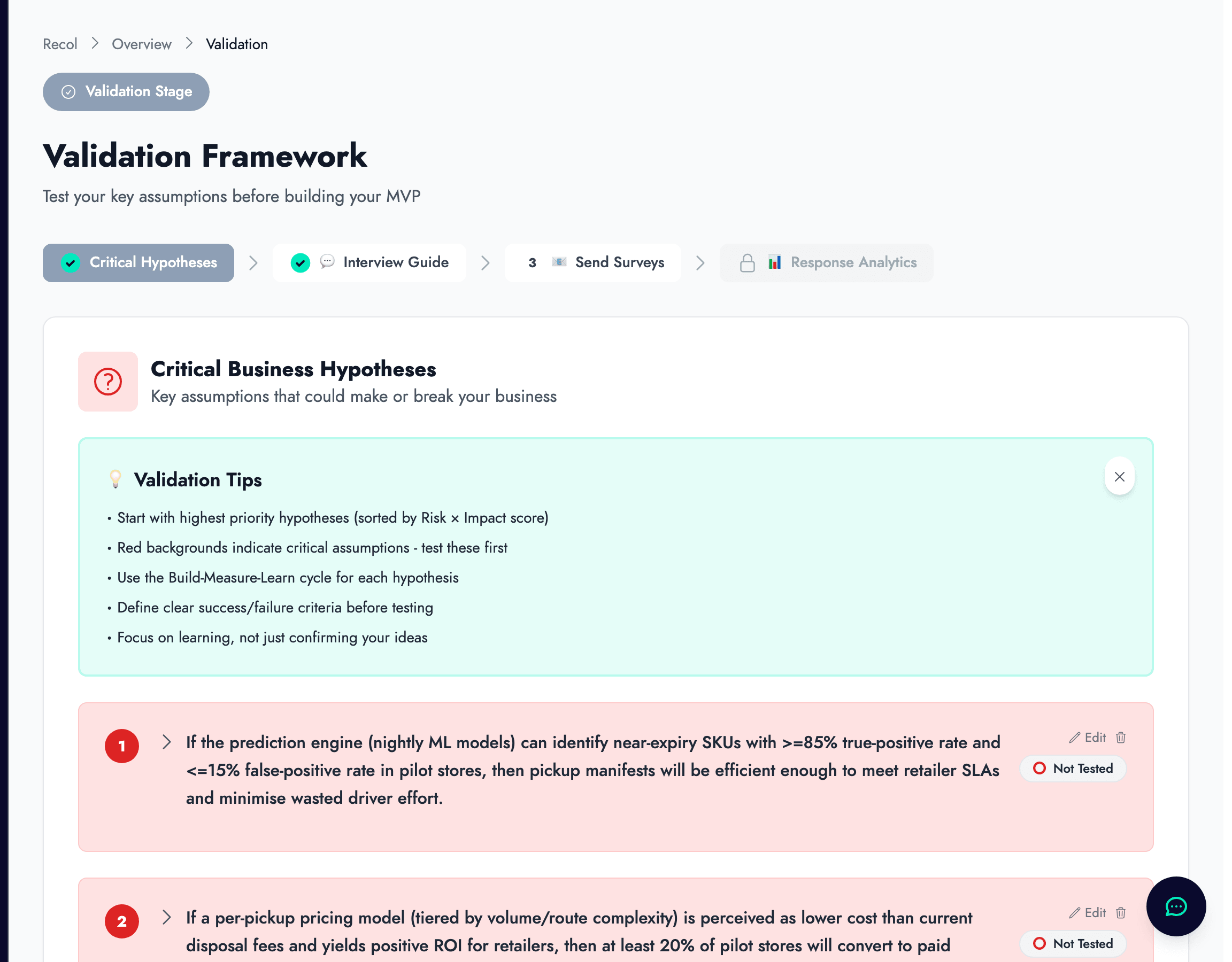
When you complete your Lean Canvas, zigzag analyzes the information you entered and surfaces five to seven critical hypotheses. Each hypothesis comes with a risk score (how uncertain the assumption is), an impact score (how much the business depends on it being true), and a priority ranking based on those two scores.
Each hypothesis also includes a suggested validation method — a specific approach you could use to test that assumption — and success criteria that define what evidence would confirm or refute it.
You can edit these hypotheses, add your own, and remove ones that feel irrelevant to your specific situation. The generated set is a starting point, not a final word. Your own knowledge of your industry and customers will often reveal hypotheses that the AI cannot surface on its own.
How to prioritize your testing
The hypotheses with the highest priority scores — where risk multiplied by impact is greatest — are the ones that deserve your attention first. If your highest-priority hypothesis turns out to be wrong, it might mean changing your customer segment, your problem statement, or your entire business model. The sooner you find that out, the better.
Testing these assumptions early saves enormous amounts of time and money. A hypothesis that you can test by having ten conversations with potential customers might save you six months of building the wrong product. That is the core logic of the Lean Startup approach, and critical hypotheses are how you operationalize it.
Treating hypotheses as living documents
Critical hypotheses are not just a planning exercise. They should be updated as you learn. As you collect evidence from validation interviews and surveys, go back and mark hypotheses as validated, invalidated, or still being tested.
When you invalidate a hypothesis — when you find evidence that an assumption is wrong — that is not a failure. It is the most valuable outcome possible at this stage. It means you discovered something important without building it first. Your next step is to go back to your Lean Canvas, update the affected sections, and revisit your hypotheses with your new understanding.